
Maruti Suzuki e-Vitara : Maruti Suzuki e‑Vitara is finally here as the company’s first all‑electric SUV for India, graduating from eVX concept to a full‑blown production model with up to 543 km claimed range, dual battery options and a 5‑star Bharat NCAP safety rating.
Unveiled at Bharat Mobility Global Expo 2025 and sold via NEXA, it targets the hot midsize e‑SUV segment against Tata Curvv EV, Hyundai Creta EV and MG ZS EV, with expected prices in the ₹17–22.5 lakh bracket depending on variant and battery pack.
Design and Platform: From eVX Concept to Production SUV
The e‑Vitara is the production version of the eVX concept first seen at Auto Expo 2023, riding on Suzuki’s new dedicated BEV architecture called Heartect‑e.
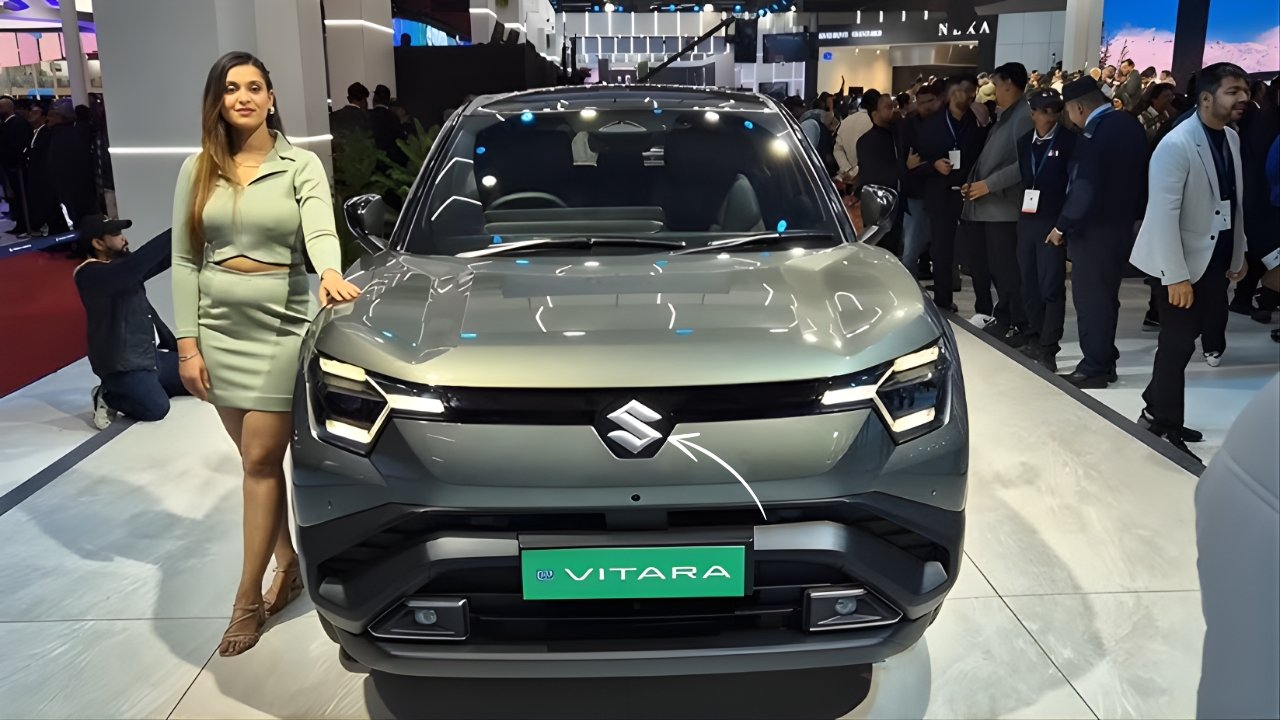
The design stays close to the concept: a high bonnet, upright nose with slim LED headlamps, full‑width DRL strip and pronounced cladding to deliver a tough SUV stance.
At the rear, it uses connected tail‑lamps with an integrated spoiler and bold e‑Vitara lettering on the tailgate, reinforcing its EV identity.
Globally, Suzuki unveiled the e‑Vitara in Italy first, confirming it as the brand’s first BEV with India as a key production and launch hub.
Battery, Motor and Range
Maruti Suzuki offers the e‑Vitara with two battery pack options. Indian and global reports talk about:
- A 49 kWh pack paired with an electric motor of roughly 105–106 kW (around 142 bhp), targeting an ARAI range in the 440–450 km zone.
- A larger 61 kWh pack with a motor rated up to about 128 kW (around 172 bhp), pushing the claimed range to over 500 km, with ARAI figures quoted as high as 543 km in India‑spec form.
Both versions drive through a single‑speed reduction gear, with top speed capped near 160 kmph and 0–100 kmph performance aimed to be competitive with other midsize EV SUVs rather than hyper‑quick.
DC fast‑charging is supported, with typical figures suggesting 10–80% top‑ups in under an hour on suitable chargers, while AC home charging takes around 6–8 hours depending on charger and battery size.
ALLGRIP‑e: Electric AWD for Trails
A highlight is Suzuki’s new ALLGRIP‑e electric 4WD system on higher trims. Unlike mechanical AWD, it uses independent e‑axles front and rear, each with its own motor, allowing precise torque vectoring between axles.
Trail Mode applies selective braking to spinning wheels and redirects torque to the tyres with grip, mimicking a limited‑slip differential for better escape on rough terrain, sand or slush.
This setup gives the e‑Vitara genuine light off‑road credentials while preserving the packaging and efficiency advantages of a flat battery platform.
Interior, Tech and Features
Inside, the e‑Vitara follows current NEXA design themes: squared‑off AC vents, a neat, layered dash and a two‑spoke steering wheel.
Top variants get a dual‑screen cockpit—roughly a 10.1‑inch digital driver cluster and a 10.25‑inch touchscreen infotainment unit—with wireless Android Auto and Apple CarPlay plus Suzuki Connect telematics.
The EV also offers ambient lighting, ventilated front seats, a 360‑degree camera, wireless phone charging and a premium audio system on higher trims.
The cabin is configured as a five‑seater with a flat floor, thanks to the skateboard‑style platform, and is aimed at practical family use rather than being a cramped “crossover coupe”.
Safety: 5‑Star B‑NCAP and ADAS
Maruti has pushed hard on safety with the e‑Vitara, securing a 5‑star rating under Bharat NCAP in Indian‑spec crash tests according to early media drives.
The SUV’s safety kit includes up to seven airbags, ABS with EBD, ESC, hill‑hold and ISOFIX mounts as standard or in higher trims, alongside strong body‑in‑white engineering to meet global crash norms.
On the tech side, Level 2 ADAS features such as adaptive cruise control, lane‑keeping assistance and autonomous emergency braking have been highlighted in launch coverage, moving Maruti closer to rivals already offering ADAS in this segment.
Launch Timeline, Pricing and Network Strategy
Maruti Suzuki formally unveiled the e‑Vitara at Bharat Mobility Global Expo 2025, announcing it as its first BEV for the Indian market under the broader “e for me” electric ecosystem.
Production is centred at Suzuki’s Gujarat plant, with about half of the output earmarked for export to Japan and Europe under Suzuki badging, explaining why the initial global debut happened in Europe.
Launch dates and price windows differ slightly across reports, but most converge on an India launch between late 2025 and early 2026, with indicative ex‑showroom pricing roughly in the ₹15–22.5 lakh band depending on battery size and trim.
Some Hindi reports note that although production has started at Hansalpur, market launch and price announcement have seen minor delays before settling on this new timeline.
Maruti Suzuki e-Vitara : Maruti’s Big EV Bet
Beyond just being “another EV,” the e‑Vitara is central to Maruti’s EV roadmap. The company has positioned it alongside a nationwide charging and ownership ecosystem: media coverage mentions access to over 2,000 chargers in 1,100 cities at launch, with a target of 1 lakh charging points by 2030.
Maruti is also experimenting with Battery‑as‑a‑Service, subscription‑style plans and assured buyback schemes to address range anxiety and resale worries, signalling a serious push to make EV ownership feel familiar to existing Maruti users.
The model will also spawn a Toyota twin—previewed by Toyota’s Urban SUV concept—that will share the platform and much of the hardware but wear distinct styling. Together, they mark India’s first major volume EV push from the Maruti–Toyota alliance in the midsize SUV segment.
In short, the Maruti Suzuki e‑Vitara turns the long‑teased eVX into a production reality: a made‑in‑India, exported‑globally electric SUV with credible range, electric AWD, strong safety and a mass‑market badge.
How aggressively Maruti prices and supports it will decide whether this first step sets the tone for a genuine EV revolution in India’s heartland.